
A Treatise on Food: Vol. III
by afatpurplefig

My host, Zhou Mei, collects the three of us, Magnus, Hannah and me, from the front step of our hotel. I have opted out of the day’s activities, keen to be well-rested for the dinner I’ve been most looking forward to: the one that sees us welcomed into someone’s home.
We deliver Magnus and Hannah to their homestay family, then Mei and I make our way to her family’s unit. She points out the home of family members who live nearby, making it easy for them to connect. I can relate, having moved states to be closer to my family at the end of last year.
(I am enjoying having love at arm’s reach.)
Listed on our trip’s Pre-Departure Checklist is ‘small gifts representing Australia’. Guessing that I would be gifting university students, I am bearing a twelve-pack each of clip-on kangaroos and koalas, some Aussie pens and gold-plated pins, and ten of the 50 individually-wrapped Tim Tams wedged in my suitcase.
Is it an ideal family gift? No. But, c’est la vie. It is all I have.
The front door is dressed in red and gold. We step through, and I swap my sneakers for slides before taking a seat at the table.
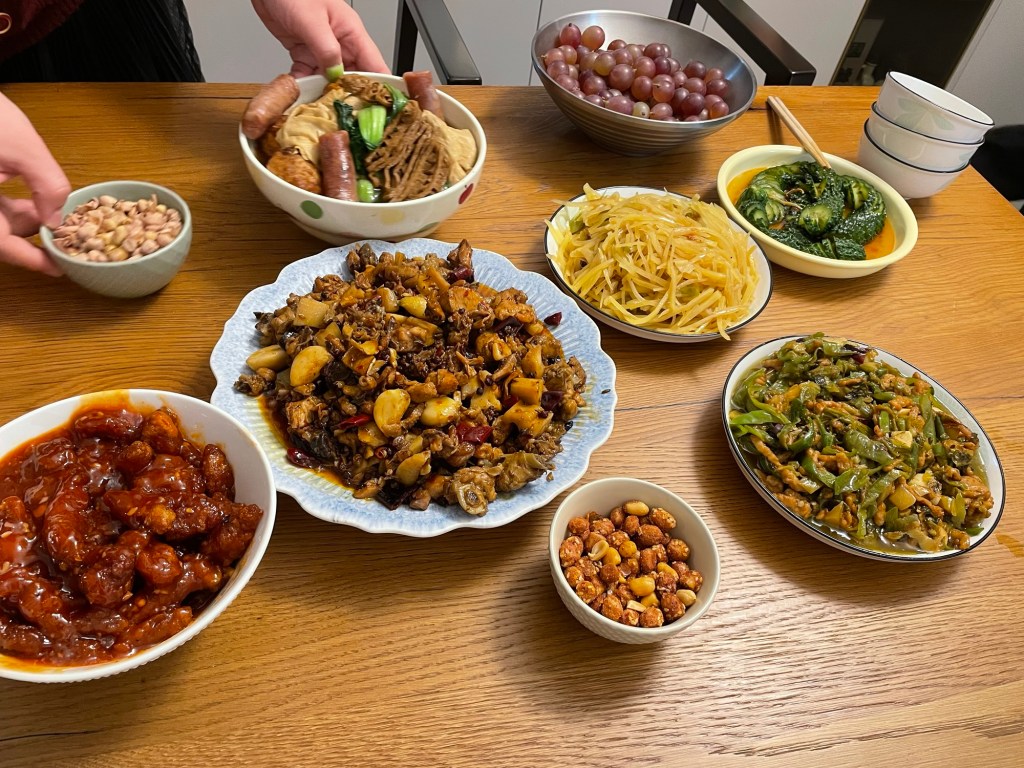
The Zhous’ niece, Lily, has joined us for dinner. Along with Master Zhou, who I suspect is around 12 years old, she has disappeared into the kitchen, leaving Mei and me to nibble at grapes, peanuts, and coated nuts.
‘Come out of there!’ she implores, before turning to me, and explaining, ‘Suddenly everyone needs to help in the kitchen.’
I get it. I am also fairly partial to busy-bee tasks on social occasions.
Mr Zhou exits the kitchen to shake my hand and welcome me to their home.
‘Would you like some wine?’ he asks.
At my agreement, Mr Zhou takes a sealed bottle of Scotch whisky from the cupboard and places it on the table. I implore him to leave it sealed, to no avail.
CRACK.
Shot glasses. One, and two.
Up, Cheers. Drink. Down.
A range of dishes is placed on the table. ‘Bought from a restaurant,’ Mei tells me.
(My kind of dinner.)
The first dish is a regional speciality, with bean curd, eggs, and sausages. I enjoy it enormously.
The conversation flows like a stream. Zhou Mei and her husband both work at the university, and are excellent conversationalists. We discuss politics, education, housing, culture, and language.
The sweet and sour pork is the only dish I have eaten in China that resembles Australian ‘Chinese’. I describe the standard Aussie order:
Spring rolls
Sweet and sour pork
Beef in black bean sauce
Chicken and cashews
Fried rice
Mr Zhou works sixty hours a week, partly for pay, and partly out of dedication to his role. I admire the role he played during Covid, living apart from his family in order to deliver meals to the students, traipsing up and down countless flights of stairs, in a hazmat suit, collecting trays.
Up, Cheers. Drink. Down.
We enjoy Dì Guō Jī, or claypot chicken, a local speciality, which was once prepared in clay pots over open flames. The bone-in chicken pieces are simmered until they take on a dark, caramelised finish, rich with the flavours of garlic, soy, and vegetables. I love a whole garlic clove.
Mei describes the trains, before they became bullets, and the experience of catching the much-slower versions to visit her husband, away in Beijing, while they were courting.
‘Was it worth it?‘ I jest, and we giggle.
Up, Cheers. Drink. Down.
The cucumber is one of the best things I have eaten since we arrived, not just because it is spicy (real spice!), but because dressed cucumber is one of the greatest accompaniments to main dishes ever devised.
Master Zhou is embarrassed by his father’s effort to communicate, and hides his face at the adolescent mortification of it all.
‘Your father’s English is so good!’ I tell him, grateful that our English conversation is so strong, given my Mandarin is so weak.
Lily asks me about my language skills, to which I demonstrate my limited repertoire:
Wǒ jiào bái fēi
Wǒ shì ào dà lì yà rén
Wǒ shì Yīngyǔ lǎoshī
Wǒ shì Hànyǔ xuéshēng
I also have a wide range of individual words, on standby for the chance to use them. Not sentences, or conversation starters, mind you…just words. Should someone forget the Mandarin word for ‘bicycle’ or ‘wristwatch’, for example, I’m at-the-ready.
I tell her about the time we were asked for single-word responses to a musician’s performance, and my hand shot up, delighted, to offer ‘piàoliang!‘, before someone else got in first.
We have to make the most of our opportunities.
We chat about her major (HR), future study prospects (Master’s degree), and television programs of note (Desperate Housewives), while I search for a picture of my favourite Chinese drama heroine, Dou Zhao from Blossom.
We intersperse tea with whisky, both of which Mr Zhou refills seamlessly.
Mei takes a bag of frozen treats from the freezer. ‘No, no,’ I protest, ‘…don’t cook them just for me!‘ but, of course, she does it anyway, and soon produces a steaming plate of traditional Chinese cakes. I choose a butter-yellow one, with a sweet, warm filling.

When it is time to leave, they offer me a gift – a beautiful scarf, 100% silk, in pale pinks and blues.
‘Piàoliang!‘
‘Xièxie. Xièxie.‘
(Such moments are not built for words.)

 A Fat Purple Fig
The kind of experience money rarely is able to buy: genuine connection.