
The Robusta Rulebook
by afatpurplefig

We leave at 8am, bound for 42 Nguyen Hue, an apartment building that housed government officials and shipyard workers before becoming a social media darling known as the Coffee Apartments. Getting there is more challenging than anticipated. ‘I can feel sweat streaming down my inner thighs’, I tell a harried Eva, whose own droplets are forming on her temples and chin. The heat is cloying, but nobody but us seems remotely bothered by it, slurping their soup on stools dotted all over the footpaths.
Road crossings are harrowing. There is a light system, but nobody seems to follow it. The bigger intersections do provide a red light, combined with a person-shaped green outline to encourage pedestrians to cross, but the sea of bikes turning is often as big as the deluge that has stopped, so it makes little difference. The red lights appear suggestive, with many breaking ranks to avoid coming to a standstill. I have initiated an unofficial search for the most astonishing use of a motorbike. This guy is low-key, yet notable.

We sit on a wooden bench on the boulevard that was once a canal, mopping our brows and watching children dance as we await our coffee host, Quynh.

Introductions and lift-fee payment aside, Quynh accompanies us to the ninth floor, where we enter his tiny store. It houses a fridge and coffee machine, manned by a mysterious barista, and a cool, enclosed balcony. As we photograph the view, he tells us this was once the tallest building in Saigon.

Our education in Vietnamese coffee begins with an iced coconut version (inspiring a sneaky glance of approval between Eva and me) and a disclaimer from Quynh that we might want to sleep through the history section.
I think not.

Quynh’s history lesson is as detailed as it is fascinating. Did you know Vietnam is the world’s second-largest producer of coffee? Nor did I. Their 1.9 million tonnes make up 20% of the world’s coffee, placing them behind only Brazil. As we sip our cold brew, we develop a fondness for the Robusta coffee plant, much maligned for the bitter quality of its beans, but whose hardiness made it instrumental in revitalising the Vietnamese economy. ‘Weak! Pathetic!’ Eva and I exclaim, whenever discussion turns to the inherent delicacy of Arabica beans.


Here’s the thing though; Robusta coffee is exactly that – robust – with caffeine levels that are more than double that of Arabica (weak! pathetic!). The Vietnamese mix their kick-arse beans with soybeans, vegetable oil, butter, chocolate, and whisky or rum (yesiree, you read that right), to create a kind of thick, burnt, bitter blend that can keep up with the rule of the 4D – đen đậm đặc đắng – which I like to translate to ‘don’t be a sook’.


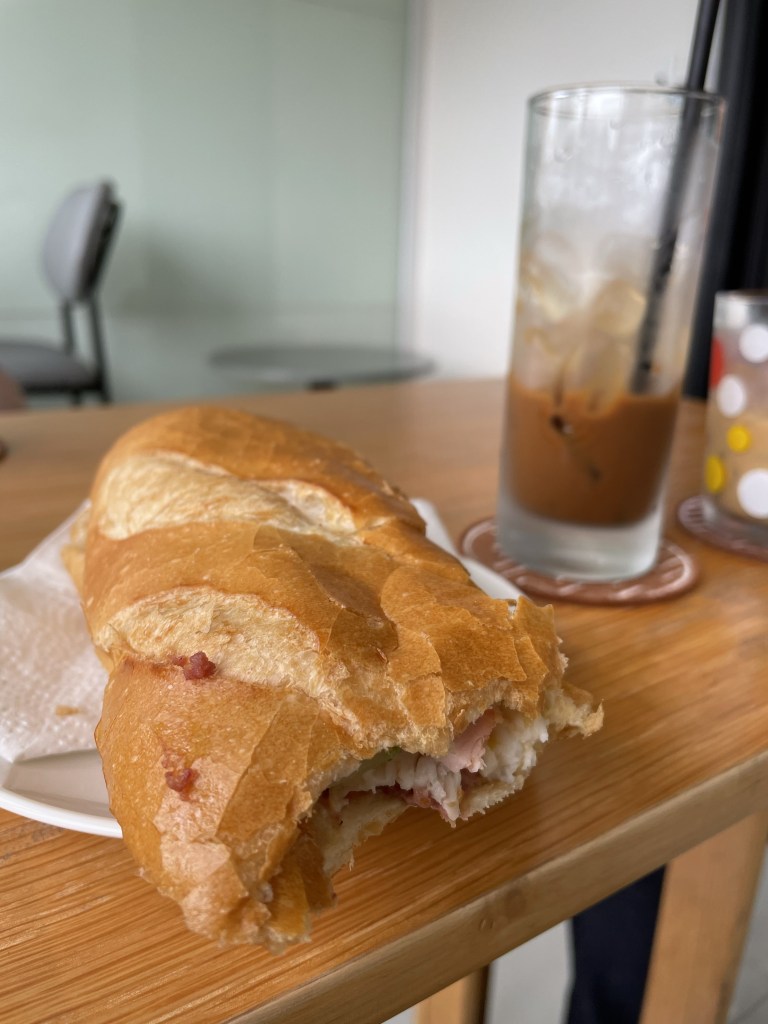
Quynh shows us how not to brew coffee in a phin (‘please taste how not to make it’), then demonstrates what can be achieved with a little finesse and some condensed milk, which isn’t actually milk at all, but a mix of sugar, vegetable oil and milk powder. This produces the standout coffee of the day, pictured here alongside an increasingly-popular, weaker variety, because the youth of today have no guts. We sip it as we enjoy our first bánh mì in Vietnam, served in order to, in Quynh’s own words, ‘tolerate the much cafein we’ll consume’.


Quynh further demonstrates the alchemy of Vietnamese coffee, by whipping us up an egg coffee…literally. As he blends egg yolks and salt to a thick, creamy consistency, he describes the years he spent studying in Hanoi, before deciding to abandon future government employment in favour of a life ‘filled with conversations like this one’.
I like his thinking.
As we sip our final drink of the day, coffee tea made with the skins of Robusta beans, I begin to understand why Starbucks has failed to crack the Vietnamese market as anticipated. Coffee here is no mere drink, but a cultural tradition with deep historical ties. In fact, Quynh tells us that ‘meet me for a coffee’ means ‘let’s spend some time together as friends’ and need not involve coffee at all. This stems from the time it takes for the brew to drip through the phin, and the conversation that often occurs as a result of waiting.

This means, in Vietnam, coffee is a literal synonym for connection.
 A Fat Purple Fig
Just lovely. Let’s have coffee soon!